
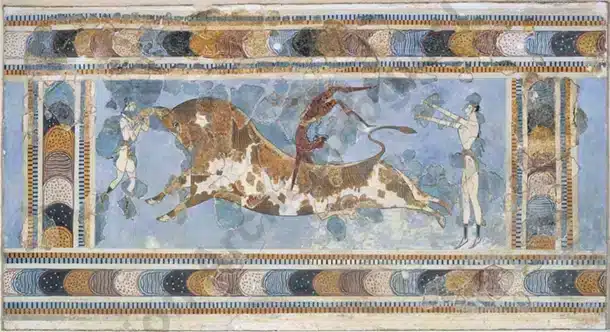
In the Aegean world, power is first framed as mastery over danger within ritual. The famed bull‑leaping imagery from Knossos pairs athletic torsion with the animal’s charge, staging sanctioned risk as communal spectacle. The Heraklion Archaerological Museum’s entry on the Taureador (Bull‑Leaping) Fresco situates the motif as emblematic of Knossos—strength, fertility, and elite performance embedded in palace culture, not private revolt; see the museum’s description of the Bull‑Leaping Fresco for context. Luxury ritual objects echo the same logic: the bull’s‑head rhyton, a libation vessel used for offerings, fuses polished, dark stone with controlled apertures to choreograph flow—ritual power literally poured from the bull’s neck, as outlined by Heraklion’s page for the Bull’s‑Head Rhyton.
For designers, the visual grammar is clear. Diagonals and torsion encode dynamism without anarchy; the silhouette rides the sweep of the horns and muzzle mass; dark, lustrous surfaces read as gravitas. Even small antecedents like the ivory bull‑leaper figurine highlight a rhythmic, athletic line that contains danger rather than glorifying rupture. In short, early bull symbolism in sculpture tends to serve civic order—power choreographed, not defied.
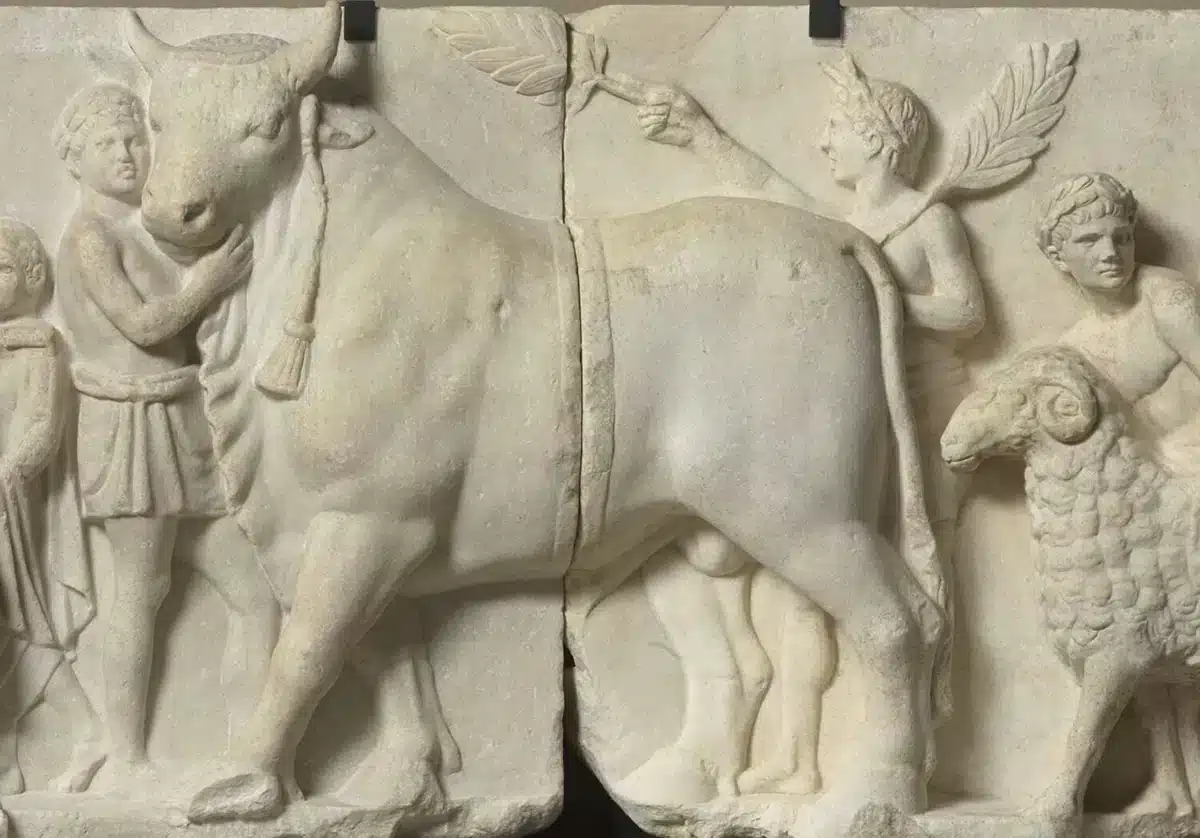
Roman imagery regularizes and expands the repertoire, shifting from spectacle to codified authority. Reliefs associated with the suovetaurilia—the pig‑sheep‑bull purification rite—present processional order and officiants that make power legible as ritual bureaucracy. The Louvre’s ARK entry for the Ahenobarbus ensemble confirms the work’s identity as a multi‑panel Parian marble relief tied to elite civic ceremony; the institutional catalogue foregrounds object class and condition while anchoring its official context. See the museum’s description of the Autel de Domitius Ahenobarbus reliefs for the canonical reference.
A different, but equally codified, system appears in the Mithraic tauroctony. Across many surviving statues and reliefs, Mithras in a Phrygian cap drives a dagger into the bull’s shoulder as a dog and snake drink the blood, a scorpion grips the genitals, and torchbearers flank the scene in some versions. The British Museum’s collection entries detail these constants without forcing a single doctrine, underscoring the icon’s standardized, initiatory function; for a representative example, consult the museum’s page for a Roman marble Mithras tauroctony.
Formally, Rome privileges frontal clarity that reads in narrative bands: officiants align, victims advance, gods and attributes punctuate the field. Here bull symbolism in sculpture grounds state piety and cosmic sanction. The animal no longer signifies merely tamed ferocity; it becomes the very medium through which the state purifies itself or a community rehearses salvation.
The discovery and princely display of monumental antiquities reignited the bull’s symbolic charge. The colossal group known as the Farnese Bull (Toro Farnese)—a Roman marble after a Hellenistic original—centers the myth of Dirce bound to a bull and dramatizes punishment as spectacle. The National Archaeological Museum of Naples provides the canonical anchor for provenance and significance; see the institution’s page on the Farnese Bull for the official context.
As courts collected and studied antiquity, sculptors translated ancient dynamism into bronze. Giambologna and his circle refined the figura serpentinata—a spiral composition encouraging 360‑degree viewing—precisely the kind of torsion that conveys contained power and potential rupture depending on how tightly the helix is tuned. The Metropolitan Museum of Art’s essays outline how Renaissance bronzes relied on the lost‑wax method and how surface chasing and patination heighten a form’s optical drama; see the Met’s overview on Bronze Sculpture in the Renaissance for process and context.
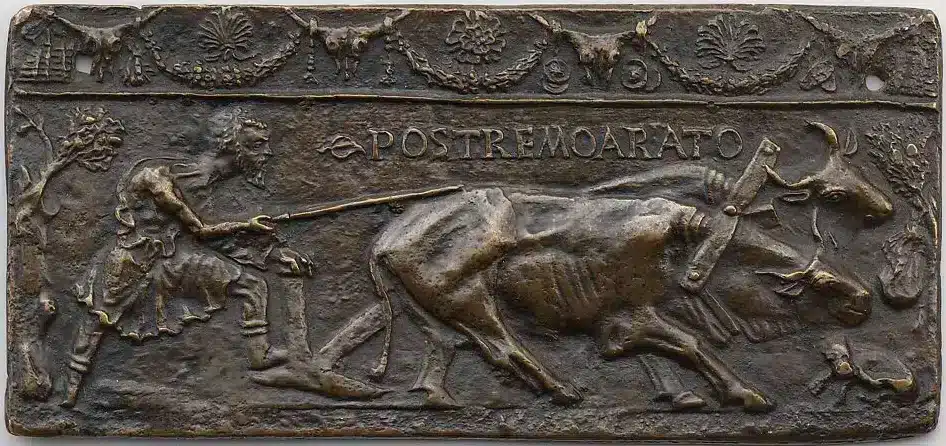
Material matters here. Bronze’s tensile strength enables outstretched limbs, fine horns, and asymmetric loads that marble might resist only at great risk. Patina modulation acts like chiaroscuro, catching edges and sinking planes to project authority without resorting to literal ornament. When you want to read power as dynastic confidence, spiral the mass, articulate the lines, and let the patina “hold the light” on the crests.
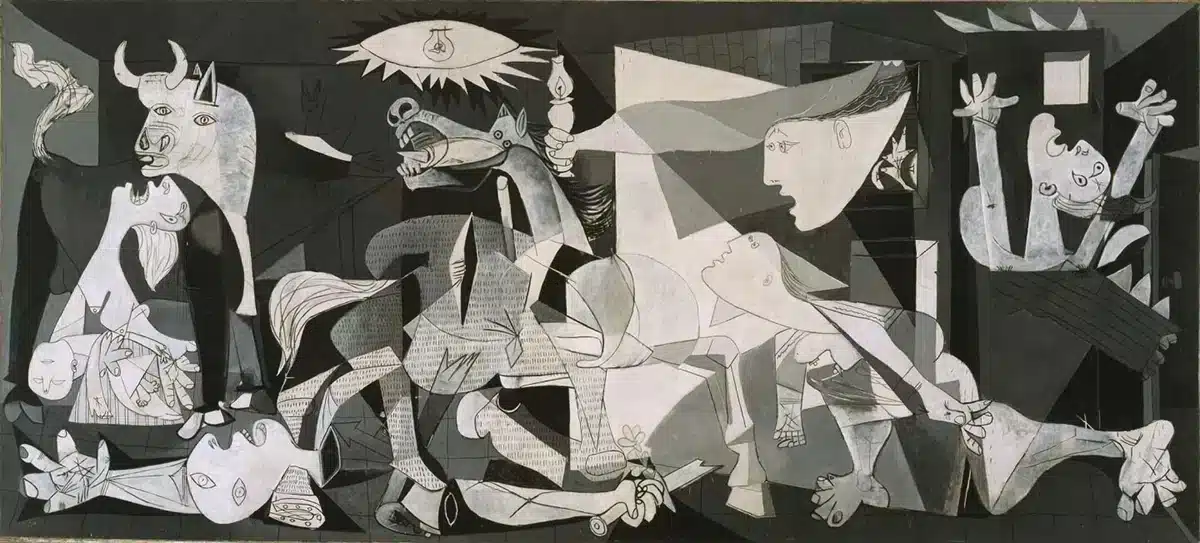
Modernism breaks open the code. The bull no longer sits within a stable grammar of rite and princely order; it becomes ambiguous, even weaponized. In Picasso’s Guernica (1937), the bull and horse participate in a symbolic language the artist forged for the painting; the museum itself resists reducing the bull to a single label. The Museo Reina Sofía foregrounds the work’s symbolic vocabulary without endorsing one definitive decoding; see the institution’s page for Guernica.
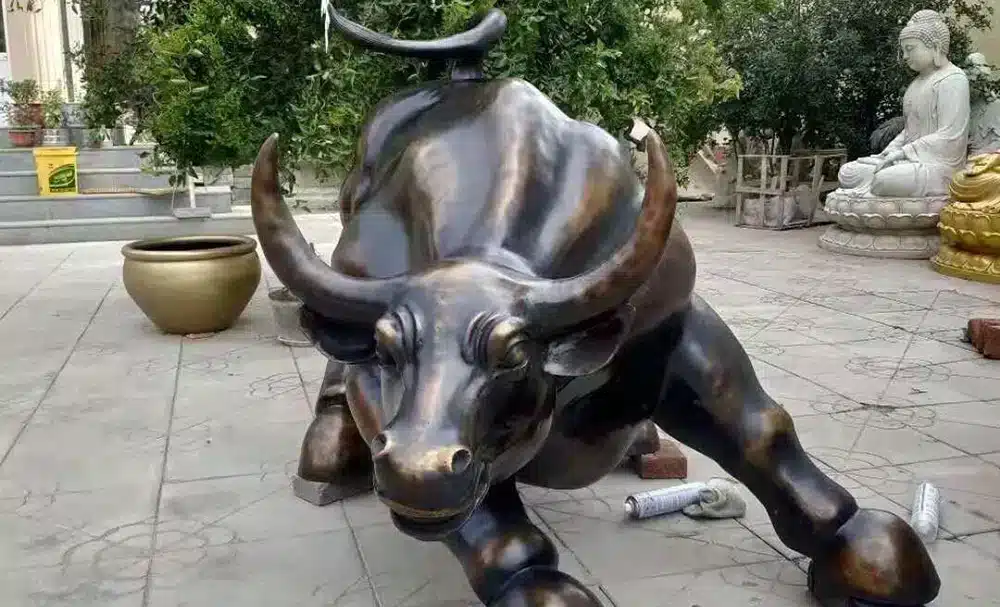
Public sculpture complicates it further. Arturo Di Modica’s Charging Bull began as an unsanctioned drop outside the New York Stock Exchange in 1989 and soon migrated to Bowling Green, where it reads as market optimism to some and a magnet for counter‑symbolic gestures to others. The NYC Parks history of Bowling Green records the placement and civic framing; consult NYC Parks’ Bowling Green history for the official timeline. Here, rebellion resides not just in imagery but in the act of placement, while highly polished surfaces and forward‑leaning stance amplify a sensation of momentum and risk.
For contemporary designers, this phase shows how pose, finish reflectivity, and site lines can tilt readings toward celebration or critique. A squared, massive stance with matte finishes suggests enduring institutional weight; a lunging, low‑plinth installation with mirrored surfaces invites selfies—and friction.
In ancient Greece and Rome, interaction with the bull was strictly choreographed by priests; the public remained spectators. Today, the installation of public art democratizes that interaction, transforming civic spaces into arenas of tactile participation. We have replaced the ancient sacrifice with a new modern ritual: touching the sculpture for luck.
The “Living” Patina: When designing a bronze bull for a high-traffic pedestrian zone, sculptors must anticipate human interaction. The horns, snout, or hooves will inevitably be rubbed by thousands of hands. Over time, the oils from human hands wear away the applied chemical patina, polishing the underlying bronze to a brilliant, golden shine.

Designing for Touch: This evolving surface should be treated as an intentional design feature rather than a maintenance failure. By engineering specific “high-touch” zones to be accessible and devoid of sharp, dangerous edges, designers can encourage public interaction, turning a static object into a community touchstone.