The most influential polar bear sculptures
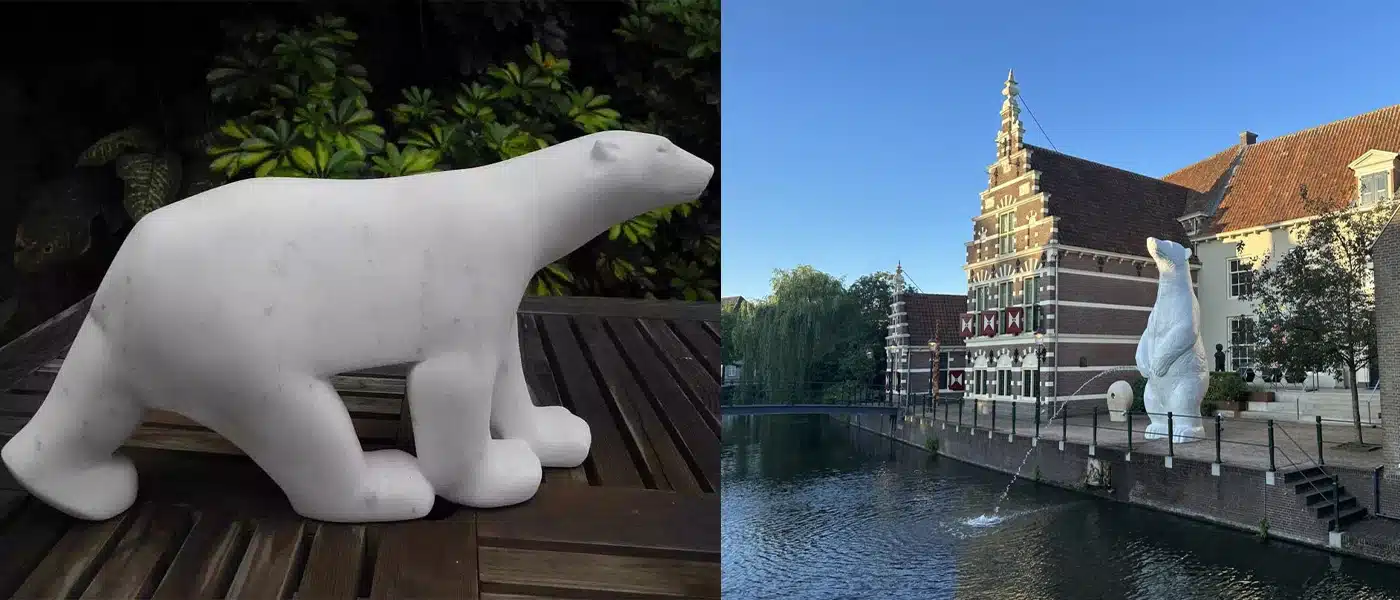
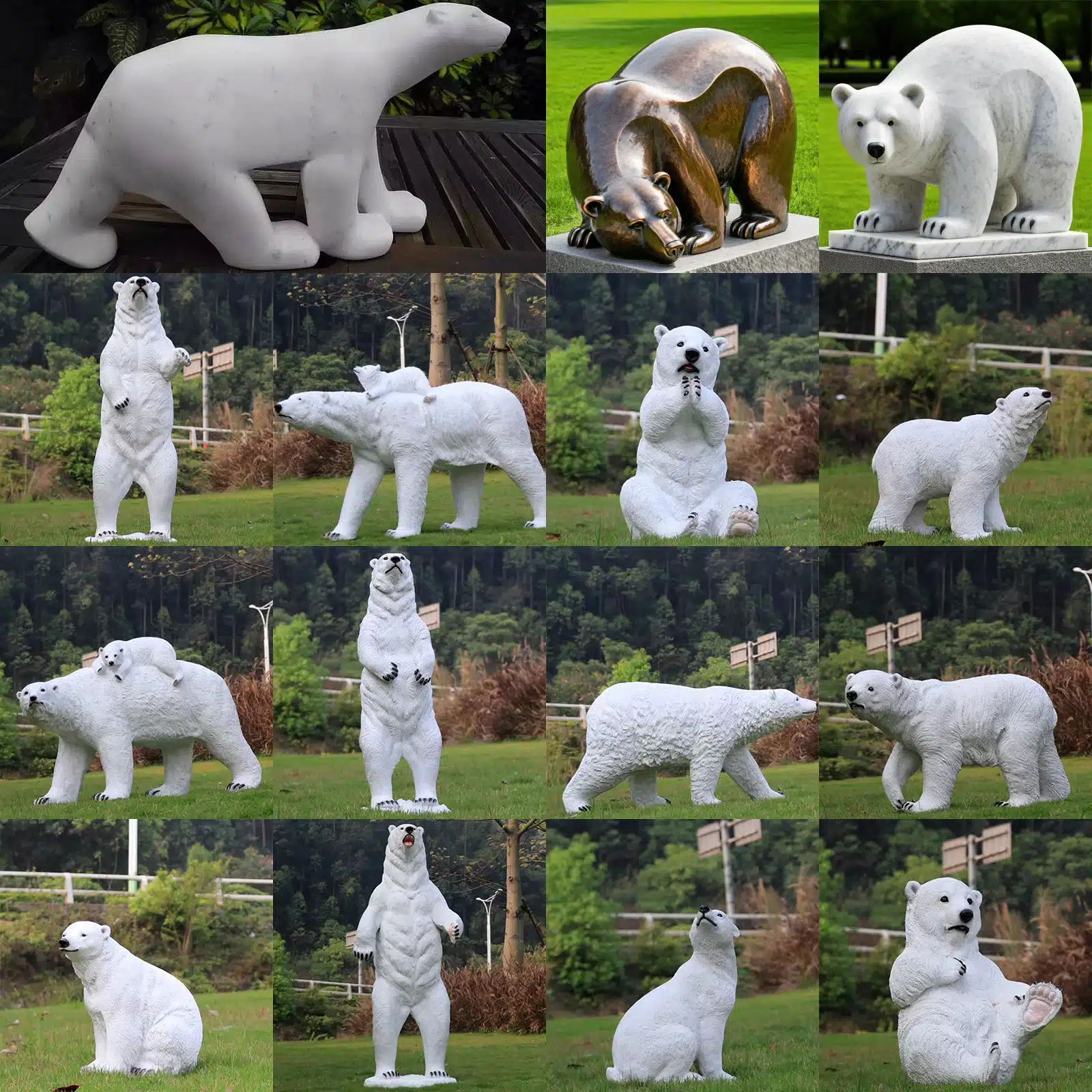
1) François Pompon — Ours blanc (Polar Bear)
One‑line positioning: The canonical modern animalier—reductive massing and serene proportion that set the template for a century of bear sculpture.
Artist / Work / Year(s): François Pompon, Ours blanc (Polar Bear); life‑size plaster debut 1922; marble/bronze/other variants c. 1923–1933.
Medium & dimensions: Multiple authorized variants and scales. A marble version at The Met measures 28.6 × 47 × 17.1 cm.
Proportion & style (2–3):
Smooth, continuous contour replaces fur detail with volume and light.
Low, elongated stride balances weight and calm—movement without fuss.
Reduction over description: mass first, minutiae second.
Art-historical significance: Celebrated after its 1922 Salon d’Automne debut; widely cited as Pompon’s defining contribution to modern sculpture and often framed within Art Deco-era refinement, as seen in the Musée d’Orsay’s collection text and The Met’s cataloging.
Collection/Location(s) + visibility: Musée d’Orsay (Paris; collection icon); The Metropolitan Museum of Art (New York; marble variant, subject to rotation). See the Musée d’Orsay’s official entry and The Met’s collection page for details and current status.
Pros/considerations:
Multiple variants require careful labeling; dimensions differ by edition/material.
“On view” status changes—check museum pages before going.
2) Paola Pivi — Feathered Polar Bear series
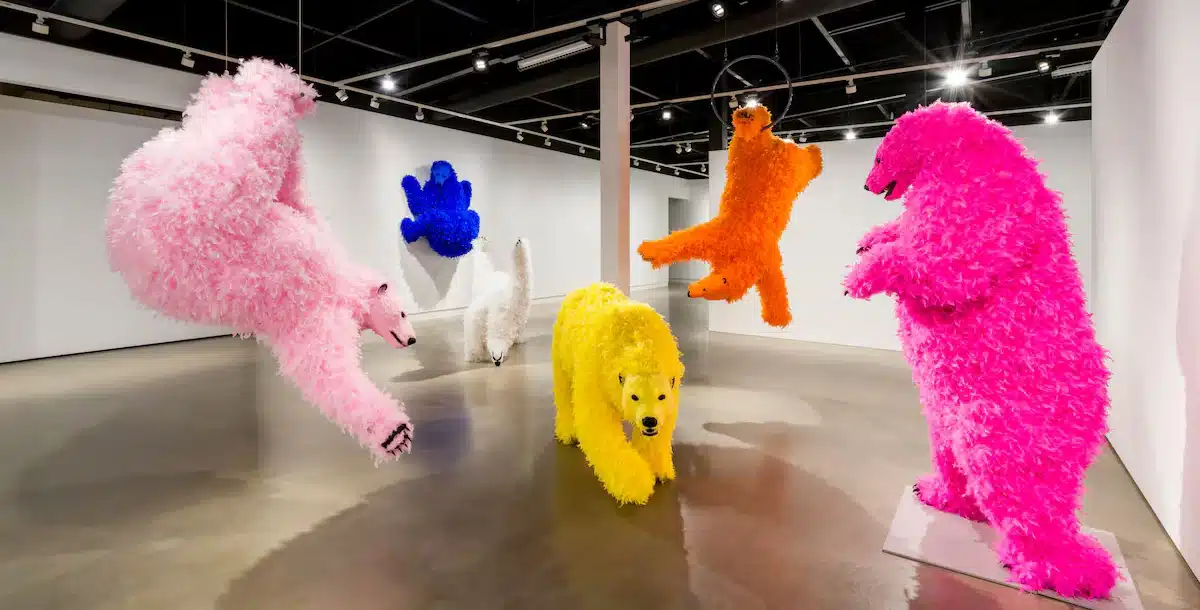
One‑line positioning: A surreal re-skinning of the bear—bright feathers, anthropomorphic poses, and pop‑cultural charge.
Artist / Work / Year(s): Paola Pivi, feathered polar bears, 2007/2008–present (various editions/ensembles).
Medium & dimensions: Life-sized and small‑scale bears sheathed in multicolored feathers; substrates/armatures are not specified on the cited institutional pages.
Proportion & style (2–3):
Species legibility remains, but feathers displace fur—categorical dissonance by design.
Anthropomorphic stances (groupings, “performances”) heighten theatrical reading.
Color and pose override naturalism, redirecting attention to cultural symbolism.
Art-historical significance: Pivi’s bears have become signature images within discussions of spectacle and the Anthropocene, consolidated through major U.S. museum presentations in 2021–22.
Collection/Location(s) + visibility: Aspen Art Museum, “Bear Like Me” (Dec 3, 2021–Aug 5, 2022, past); The Andy Warhol Museum, “Paola Pivi: I Want It All” (Apr 22–Aug 15, 2022, past). Future visibility depends on new exhibitions or private/public loans.
Pros/considerations:
Feather conservation is delicate; environment and handling matter.
Titles/years vary by installation; verify edition specifics.
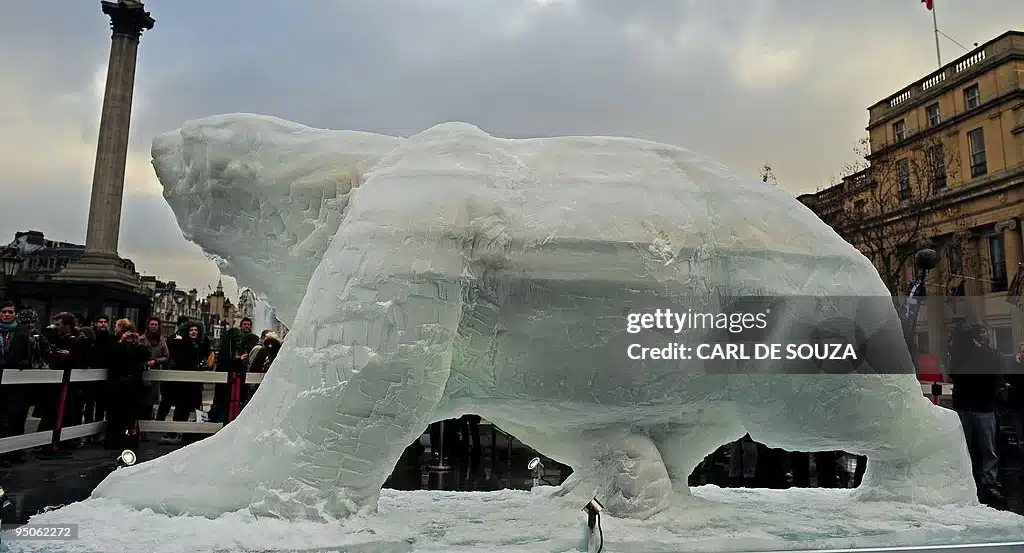
3) Mark Coreth — Ice Bear (aka Polar Bear on Thin Ice)
One‑line positioning: A time‑based public sculpture that melts to reveal its bronze skeleton—climate fragility made visible.
Artist / Work / Year(s): Mark Coreth, Ice Bear (initiated 2009; reiterations in multiple cities).
Medium & dimensions: Approximately nine‑ton ice block carved in public over a bronze armature; designed to melt in situ.
Proportion & style (2–3):
Life‑size modeling anchors species recognition before the melt.
Dissolving mass turns proportion into process—form equals message.
Public proximity (touch, photography) folds audience into the artwork’s timeline.
Art-historical significance: Among the late‑2000s’ most covered climate‑art interventions, coinciding with COP15; documented by institutional partners and media.
Collection/Location(s) + visibility: Ephemeral installations in civic squares—Trafalgar Square (London, Dec 2009) and Copenhagen during COP15, with further recreations documented in subsequent years. No permanent version.
Pros/considerations:
Weather and site logistics govern safety and duration.
Documentation (films, NGO pages) becomes the enduring record.
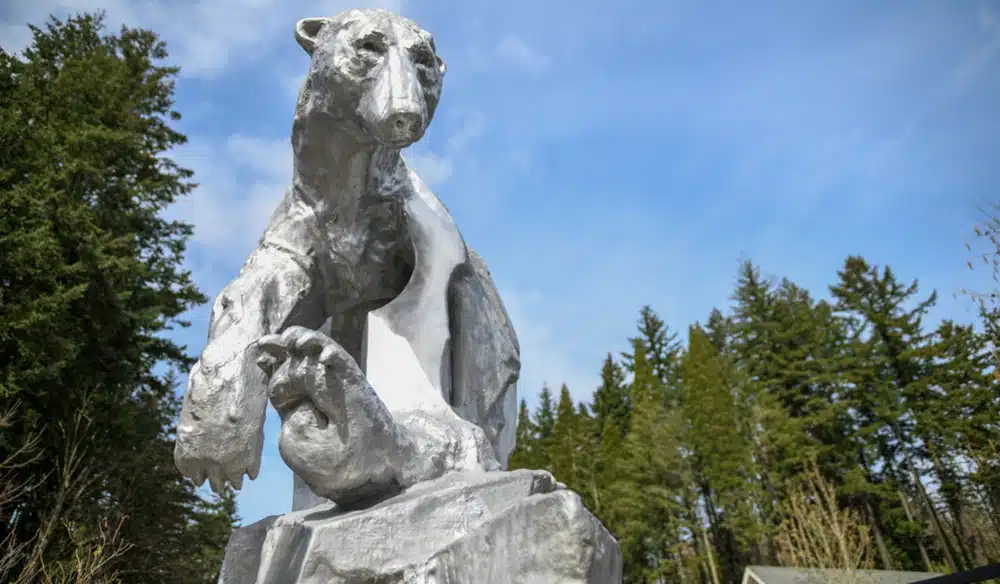
4) Veronica & Edwin Dam de Nogales — Melting Ice Bear (Oregon Zoo)
One‑line positioning: A nine‑foot aluminum landmark that fuses bear and ice into a durable, educational symbol at a major zoo.
Artist / Work / Year(s): Veronica & Edwin Dam de Nogales, Melting Ice Bear, installed 2021.
Medium & dimensions: Cast aluminum, approximately 9 ft tall; sited at Polar Passage near the Arctic Science Center.
Proportion & style (2–3):
Hybrid silhouette abstracts anatomy into angled “melting” planes.
Vertical emphasis maximizes visibility across an outdoor campus.
Metal fabric ensures longevity in high‑traffic conditions.
Art-historical significance: A commission embedded in conservation programming; functions as a focal point for interpretation and public learning.
Collection/Location(s) + visibility: Oregon Zoo, Portland—permanent outdoor placement (zoo hours and ticketing apply).
Pros/considerations:
Outdoor conservation planning (surface care, anchoring) is ongoing.
Additional site furnishings by the artists extend the ensemble.
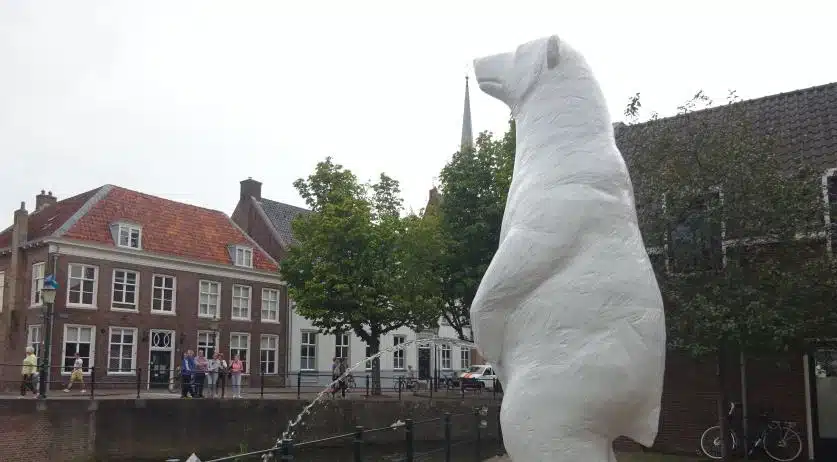
5) Florentijn Hofman — Peeing/Pissing Polar Bear
One‑line positioning: Oversized satire in public space—a bear relieving itself into canals to jar viewers into climate awareness.
Artist / Work / Year(s): Florentijn Hofman, Peeing/Pissing Polar Bear (Plassende/Pissende IJsbeer), public presentations 2023–2025.
Medium & dimensions: Large‑scale outdoor installation; sources cite roughly six meters in Alkmaar; materials not specified in the cited museum/festival pages.
Proportion & style (2–3):
Exaggerated height and simple silhouette amplify legibility from afar.
Naturalistic body plan contrasts with absurd action for satirical effect.
Site‑responsive placement along canals integrates water as a live element.
Art-historical significance: Extends Hofman’s lineage of monumental urban fauna (think Rubber Duck) into climate commentary; framed by regional museum programs and biennials.
Collection/Location(s) + visibility:
Amersfoort: Museum Flehite’s “Art & Zoo,” July–Nov 2025 (quay installation; past).
Alkmaar: Triënnale Alkmaar 2023 (regional confirmation; past).
Groningen: Groninger Museum Children’s Biennale, 2024 (bonus work outside the museum; past/ongoing status in 2024 season).
Pros/considerations:
Public safety and municipal permitting limit duration.
Media virality can outpace curatorial documentation—prefer museum press where available.
Side‑by‑side comparison matrix
Below is a quick, scannable view of the most influential polar bear sculptures, summarizing medium, scale, locations, and visibility.
Artist | Work | Year(s) | Medium | Scale | Collection/Location | Influence/Notes | Visibility |
|---|---|---|---|---|---|---|---|
François Pompon | Ours blanc (Polar Bear) | 1922 debut; c. 1923–1933 variants | Marble, plaster, bronze, porcelain (by variant) | Life‑size plaster; Met marble 28.6 × 47 × 17.1 cm | Musée d’Orsay; The Met | Canon‑defining reductive massing | Museum display (rotations) |
Paola Pivi | Feathered polar bears | 2007/2008–present | Mixed media with feathers | Life‑size and baby‑bear variants | Aspen Art Museum (2021–22, past); The Andy Warhol Museum (2022, past) | Anthropomorphic, pop‑iconic reception | Temporary exhibitions |
Mark Coreth | Ice Bear / Polar Bear on Thin Ice | 2009→ | Ice over bronze armature | Life‑size; ~9‑ton ice block | Trafalgar Square (2009); Copenhagen (2009); other recreations | Climate‑activist public art | Ephemeral, event‑based |
Dam de Nogales | Melting Ice Bear | 2021 install | Cast aluminum | ~9 ft | Oregon Zoo, Polar Passage | Conservation centerpiece | Permanent outdoor (zoo hours) |
Florentijn Hofman | Peeing/Pissing Polar Bear | 2023–2025 | Outdoor installation (materials n/s) | ~6 m (Alkmaar source) | Amersfoort; Alkmaar; Groningen | Satirical environmental commentary | Temporary site installs |
Conservation and material notes: what it takes to make—and keep—a polar bear
Stone/bronze reduction (Pompon): Marble and bronze versions endure but vary by patina and finish; surface polish accentuates contour and mass, which reads clearly under gallery lighting. Museum display rotations protect condition and rarity.
Feathers as skin (Pivi): Feathers and adhesives can be sensitive to light, humidity, and touch—why institutions emphasize controlled environments and performance‑like staging rather than open, tactile access.
Ice over bronze (Coreth): The bronze skeleton ensures structural integrity, while the ice stages a controlled loss of mass. Safety, drainage, and ambient temperature determine installation length—documentation becomes the durable artifact.
Outdoor aluminum (Dam de Nogales): Cast aluminum offers durability relative to weight; maintenance involves cleaning, inspection of joins/anchors, and monitoring surface changes.
Monumental public installs (Hofman): Fabrication details vary by venue; municipal contexts add constraints (permits, water handling) that shape where and how long the bear can “perform.”