How we chose (methodology and weights)
We evaluated seven criteria tailored for semi-outdoor environments:
Detail fidelity (25%): Fur micro-texture realism and book-edge sharpness.
Weather resistance (20%): The ability to withstand humidity, oxidation, and UV exposure.
Surface realism (15%): Color authenticity and the patina system.
Cost of ownership (15%): Cleaning and maintenance expenses projected over the next 5 years.
Installation practicality (10%): Weight, anchoring requirements, and ease of mobility.
Lead time (10%): Production and logistics duration.
Safety (5%): Tip-resistance and tactile safety in residential settings.
At‑a‑glance: best material for outdoor bear statue (semi‑outdoor)
| Material | Detail Fidelity | Weather Resistance | Maintenance Frequency | Weight / Installation | Limitations / Notes |
| Lost-Wax Bronze | Highest | Excellent | Annual clean + wax | Very heavy | High cost, requires professional anchoring |
| Cast Aluminum | Medium-High | Outstanding | Low | Lighter | Detail sharpness slightly trails bronze |
| Resin / FRP | High | Fair | Medium (UV protection needed) | Very light | Prone to chalking/discoloration under intense UV |
| Natural Stone | High (depends on stone type) | Excellent | Low (needs sealing) | Very heavy | Requires breathability, avoid acidic cleaners |
Bronze (lost‑wax) — Best for lifelike fur realism
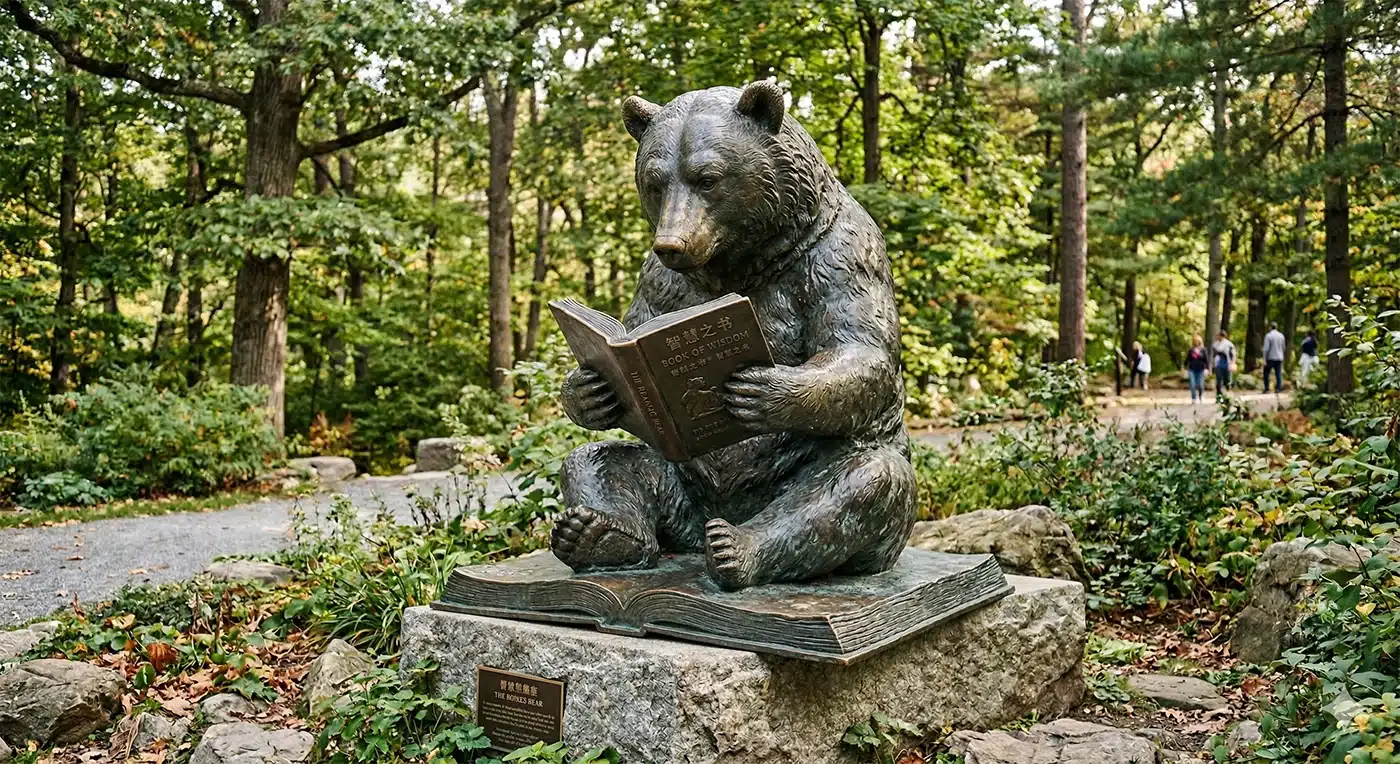
- Key traits for fur/book detail: Lost‑wax casting captures crisp undercuts, directional fur striations, and sharp page edges with fine relief. Museums document its ability to preserve intricate textures.
- Durability and weathering: Bronze weathers predictably; patinas are stable and readable in semi‑outdoor light when cared for with wax films.
- Maintenance routine and products: Gentle wash and an annual microcrystalline (or furniture) wax application, buffed to protect the patina. Increase frequency in coastal or polluted microclimates.
- Best for / Not for: Best for collectors prioritizing realism and heirloom longevity. Not for weight‑sensitive floors or ultra‑tight budgets.
- Price range (subject to change): Commonly several thousand to five figures for 2–4 ft porch‑scale figurative works, varying by edition, foundry, and complexity.
- Weight and installation needs: Heavy; plan for an anchored base plate and concealed armature where appropriate; professional handling advised.
- Finish/patina options: Broad chemical patina palette; wax‑protected finishes highlight depth and texture beautifully.
- Known limitations: Higher cost and handling complexity; patina care cycles required.
- Evidence links: According to the Victoria & Albert Museum’s overview of casting techniques, lost‑wax preserves fine textures and undercuts; conservation guidance from the Canadian Conservation Institute recommends annual washing and waxing for outdoor bronze. See the V&A’s “Rodin: production techniques” and the CCI’s “Caring for outdoor objects.”
- V&A — Rodin production techniques (lost‑wax detail): https://www.vam.ac.uk/articles/rodin-production-techniques
- CCI — Caring for outdoor objects (wash/wax guidance): https://www.canada.ca/en/conservation-institute/services/preventive-conservation/guidelines-collections/outdoor-objects.html
Cast Aluminum — Best for a low‑maintenance modern metal look

- Key traits for fur/book detail: Good surface capture when molds and castings are high quality; sand casting may soften the absolute sharpness versus lost‑wax bronze.
- Durability and weathering: Natural oxide provides inherent corrosion resistance; architectural‑grade powder or fluoropolymer coatings add UV and colorfastness.
- Maintenance routine and products: Periodic washing with mild detergent; inspect coatings for chalking/fading and touch up per manufacturer guidance.
- Best for / Not for: Best for lighter floors, lower maintenance goals, and a modern metal aesthetic. Not for collectors who demand museum‑grade undercuts equal to bronze.
- Price range (subject to change): Generally medium for porch‑scale, finishing system and complexity drive variance.
- Weight and installation needs: Significantly lighter than bronze; easier to handle; still anchor to resist wind/tip.
- Finish options: Fluoropolymer and architectural powder systems (AAMA/FGIA 2604/2605 class) with strong UV durability.
- Known limitations: Requires disciplined surface prep; high‑gloss shows dings.
- Evidence links: The Aluminum Association summarizes aluminum’s corrosion resistance; PPG explains fluoropolymer coating performance and UV durability on aluminum.
- Aluminum Association — Durability/corrosion overview: https://www.aluminum.org/sites/default/files/2021-10/GreenBuildingGuidelines_AluminumAssociation_2015_0.pdf
- PPG — Fluoropolymer vs anodizing performance: https://www.ppg.com/en-US/industrialcoatings/industrial-blog/traditional-anodizing-vs-advanced-fluoropolymer-coatings
Resin/FRP (including cold‑cast bronze) — Best for budget and light weight
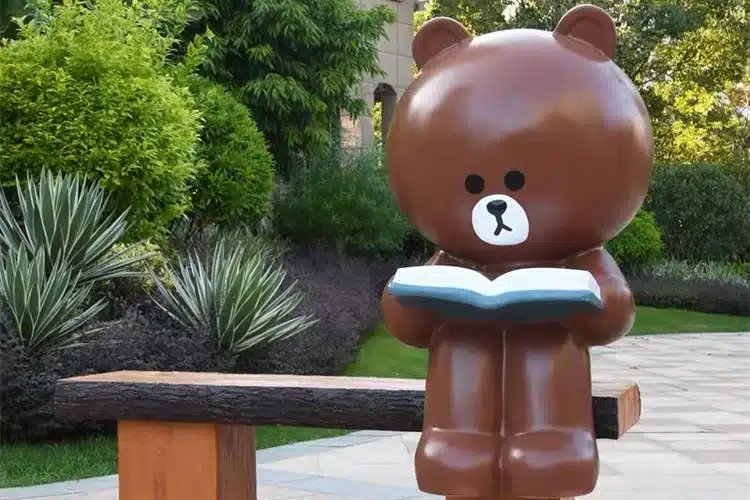
- Key traits for fur/book detail: With high‑resolution silicone molds, resin casts can replicate extremely fine textures and sharp edges; cold‑cast bronze mimics the metal look by adding metal powder to the resin matrix.
- Durability and weathering: Resin is susceptible to UV yellowing/chalking without protection. In semi‑outdoor light, a UV‑stable, marine‑grade topcoat is essential.
- Maintenance routine and products: Gentle wash; inspect annually; recoat UV‑resistant clear or pigmented topcoat per TDS (often every 1–3 years in brighter exposures).
- Best for / Not for: Best for budget‑conscious buyers, lighter floors, and movable displays. Not for high‑impact locations or intense sun without a rigorous coating plan.
- Price range (subject to change): Typically the lowest acquisition cost for 2–4 ft porch‑scale pieces; finish systems and reinforcements affect totals.
- Weight and installation needs: Light; use a wider base footprint, concealed armature where applicable, and secure anchors to counter tip risk.
- Finish options: Painted or clear systems; cold‑cast bronze finish for a metallic look; always insist on UV‑validated coatings.
- Known limitations: Lower impact/heat resistance than metals; finish longevity depends on coating maintenance.
- Evidence links: Wacker’s moldmaking literature notes the high fidelity of addition‑cure silicone molds; TotalBoat outlines adding UV protection to outdoor epoxy projects (clear coats, UV additives, and recoat signals).
- Wacker — Silicone moldmaking fidelity: https://www.wacker.com/h/medias/7854-EN.pdf
- TotalBoat — UV protection for outdoor epoxy: https://www.totalboat.com/blogs/totalboat/adding-uv-protection-to-outdoor-epoxy-projects
Natural Stone (granite/basalt) — Best for timeless, grounded aesthetics
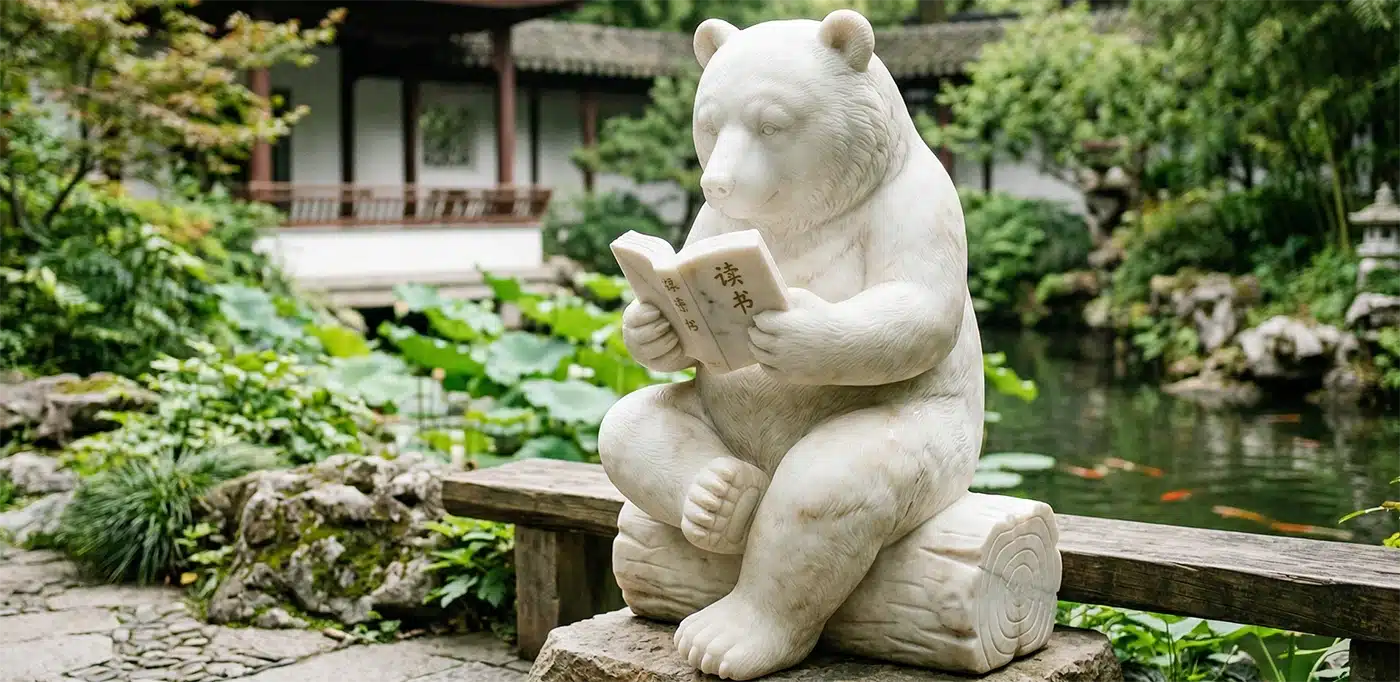
- Key traits for fur/book detail: Fine‑grained, dense stones can hold crisp chisel and rasp marks; subtle surface finishes (honed) make textures legible in porch light.
- Durability and weathering: Dense, low‑porosity stone with good drainage performs excellently; freeze–thaw risk rises when moisture is trapped.
- Maintenance routine and products: Gentle washing; use breathable silane/siloxane systems where appropriate; avoid acids on calcareous stones.
- Best for / Not for: Best for collectors who favor permanence and a quiet, natural presence. Not for tight budgets or sites with low load capacity.
- Price range (subject to change): Medium–High, with added handling/base costs.
- Weight and installation needs: Very heavy; requires professional handling and robust base/anchors.
- Finish options: Honed, bush‑hammered, or lightly polished surfaces to tune legibility of textures.
- Known limitations: Porosity varies by quarry and lithology; avoid non‑breathable topical sealers under canopies where moisture can linger.
- Evidence links: The U.S. National Park Service explains moisture and freeze–thaw considerations for traditional materials; the Natural Stone Institute provides technical resources on exterior use and treatment.
- NPS — Moisture/freeze–thaw context: https://www.nps.gov/orgs/1739/upload/book-keeping-it-clean.pdf
- Natural Stone Institute — Technical library: https://pubs.naturalstoneinstitute.org/resources/library/?event=getAdvancedSearch&mode=advancedSearch&gosearch=1
Maintenance and coating/sealing checklist (semi‑outdoor)
- Bronze: Wash with pH‑neutral soap and soft cloth/brush; apply microcrystalline or furniture wax once per year; increase frequency in coastal or polluted microclimates. Source guidance from conservation practice supports annual wash/wax cycles.
- Cast Aluminum (coated): Mild soap wash quarterly to semiannually depending on exposure; inspect for chalking/fading and touch up per coating manufacturer instructions; avoid abrasives.
- Resin/FRP: Gentle wash; keep off standing water; reapply a UV‑resistant topcoat when gloss dulls or per the product TDS (common intervals are 1–3 years in brighter exposures).
- Natural Stone: Gentle wash; consider breathable silane/siloxane sealers where appropriate; inspect for microcracks and joints; prioritize drainage to prevent trapped moisture.
Tip: Keep a simple log (date, observations, actions) so you can spot early signs like chalking, wax wear, or sealer failure before they become repairs.
Installation and safety for semi‑outdoor (porch, atrium, canopy)
- Wind and tip resistance: Favor a low center of gravity. Specify a base plate sized to the footprint and expected wind exposure; use stainless or galvanized anchors and engineer‑approved embed depths.
- Drainage and microclimate: Ensure no water pools at the bear’s feet or under the base. Provide drip edges or spacers to promote drying, especially under canopies.
- Floor load and handling: Confirm floor load capacity for metals and stone. Use professional rigging for heavier works; lighter resin/aluminum still need secure anchoring.
- Family use and access: Round sharp edges where feasible; avoid toe‑stub hazards; maintain clear egress around the plinth.
Here’s the deal: a few hours of planning with your installer and, if needed, a structural engineer prevents 90% of headaches later.
Pricing notes (indicative ranges; subject to change)
- Bronze : Typically several thousand to five figures depending on edition size, foundry, and finish complexity. Marketplace snapshots illustrate dispersion but aren’t price authorities.
- Cast Aluminum: Generally below bronze at comparable sizes; finish system and casting complexity drive variance.
- Resin/FRP: Often the lowest acquisition cost; total cost depends on the quality of the UV‑stable coating stack and recoat cadence.
- Natural Stone: Medium–High budgets plus handling/foundation costs; dense stone and artisan labor are major variables.
Always request current quotes with finish specs, crate/freight, and installation line items.
FAQ
- Will resin fade in semi‑outdoor light? Yes—unprotected resin/epoxy can yellow or chalk under UV.
- How often should I wax a bronze on a porch? Conservation guidance cites annual washing and waxing as a baseline for outdoor bronzes, with more frequent checks in coastal or polluted areas.
- Does cast aluminum corrode outdoors? Aluminum naturally forms a protective oxide layer, and with proper pretreatment plus quality powder or fluoropolymer coatings it performs very well outside.
- Which stone handles freeze–thaw best? Dense, low‑porosity stones (often granites/basalts) perform better, especially when designs prevent trapped moisture.
- Can resin match bronze for fine fur texture? High‑grade silicone molds used for resin capture extremely fine details with minimal shrinkage; bronze remains the long‑term benchmark for durable detail and patina depth.
Related Posts
- The 5 Most Influential Polar Bear Sculptures (1920s–Present)
- From Denver to Madrid: 10 Most Iconic Bear Statues Around the World
- Field Notes: Installing a Fishing Bear Statue by the Water
- Geometric Bear Sculptures: A Complete Beginner’s Guide
- How to Make Bear Statues Stand Out in Your Garden
- Where is a suitable place to display a Paddington Bear bronze statue?
- Famous Life Size Bear Sculpture in The World
- How to Integrate BE@RBRICK into Nordic, Industrial, and Wabi-Sabi