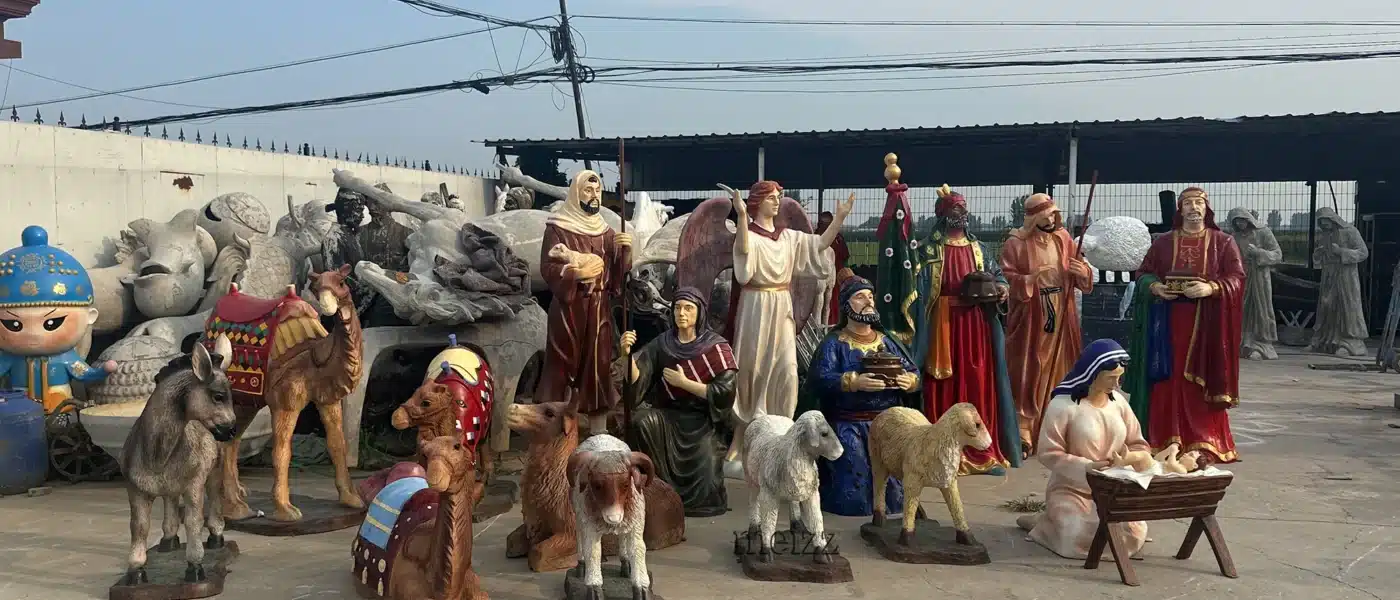
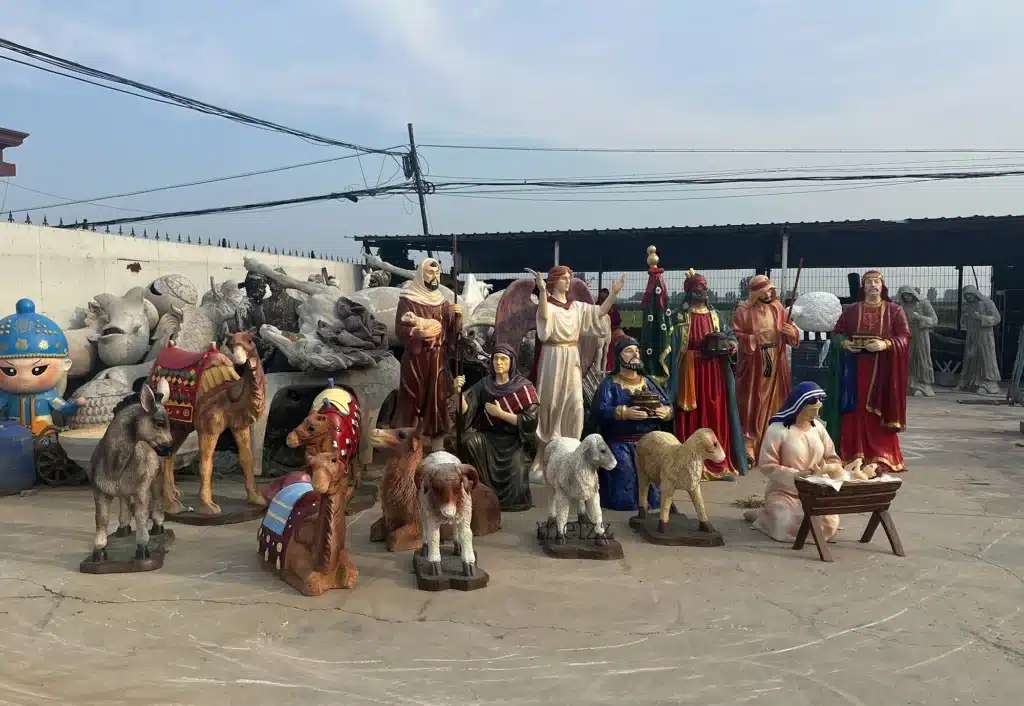
A Christmas Nativity scene can look very different from one display to another. Some contain only Mary, Joseph, and Baby Jesus. Others include shepherds, angels, the Three Wise Men, sheep, camels, donkeys, and a wide range of additional figures.
This often leads to a simple question: who is actually included in a traditional Nativity scene?
The answer depends partly on the size of the display and the tradition being followed. The core scene focuses on the birth of Jesus and the people closest to that event. Larger Nativity displays gradually expand the story by adding visitors, angels, shepherds, and animals associated with the stable or the journey to Bethlehem.
Whether you are setting up a small Christmas display at home, decorating a church, or planning a large outdoor installation, understanding the different Nativity scene figures can help create a more meaningful and organized display.
The Holy Family: The Center of the Nativity Scene
The most important figures in a traditional Nativity scene are known as the Holy Family:
- Baby Jesus
- Mary
- Joseph
These three figures usually form the visual center of the entire display.
Baby Jesus
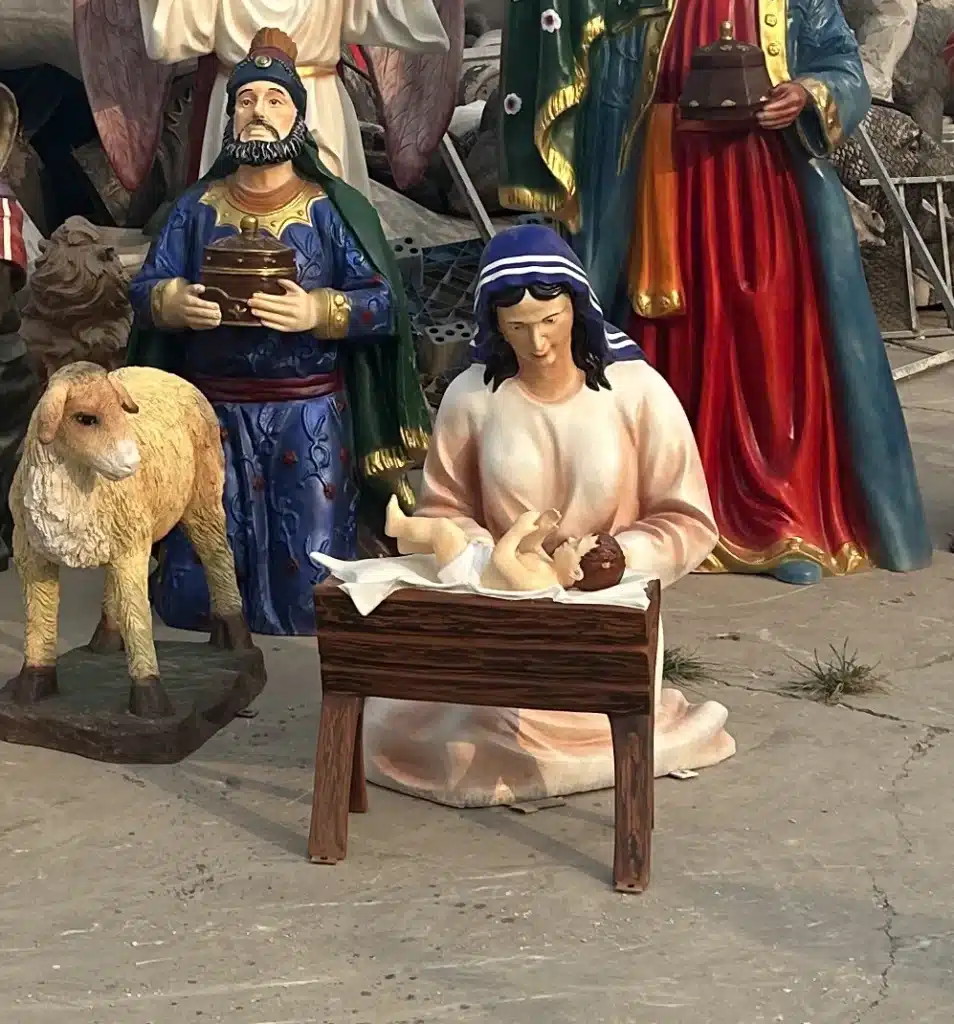
Baby Jesus is placed in a manger and represents the birth of Christ, which is the central event of the Nativity story.
In most Nativity displays, the manger is positioned at the lowest and most central point of the composition. Even when the display includes many other characters, the arrangement usually directs attention back toward the infant Jesus.
For a large outdoor scene, the manger often becomes the focal point from which the other Nativity characters are arranged.
Mary
Mary is commonly shown close to Baby Jesus. Depending on the design of the sculpture, she may be kneeling, sitting, or standing beside the manger.
Her position usually helps create a direct visual connection between the viewer and the infant Jesus. In many Nativity scenes, Mary’s clothing is painted in blue, white, or other traditional colors, although artistic interpretations vary widely.
Joseph
Joseph is generally placed near Mary and Baby Jesus. He may be shown standing with a staff or looking toward the manger.
In larger Nativity displays, Joseph can also help create a visual frame around the Holy Family, especially when shepherds and animals are placed around the central group.
Together, Mary, Joseph, and Baby Jesus form the essential group of Nativity scene figures. A display can be simple and still be immediately recognizable as a Nativity scene when these three figures are present.
The figures in a Nativity scene are not only decorative elements. Each character carries a different role within the story of Christ’s birth. If you would like to explore the symbolism behind different representations of Jesus in sculpture and religious art, you can also read our guide to the meaning of Jesus statues.
The Shepherds: Among the First Visitors
Shepherds are another familiar part of the Christmas Nativity scene.
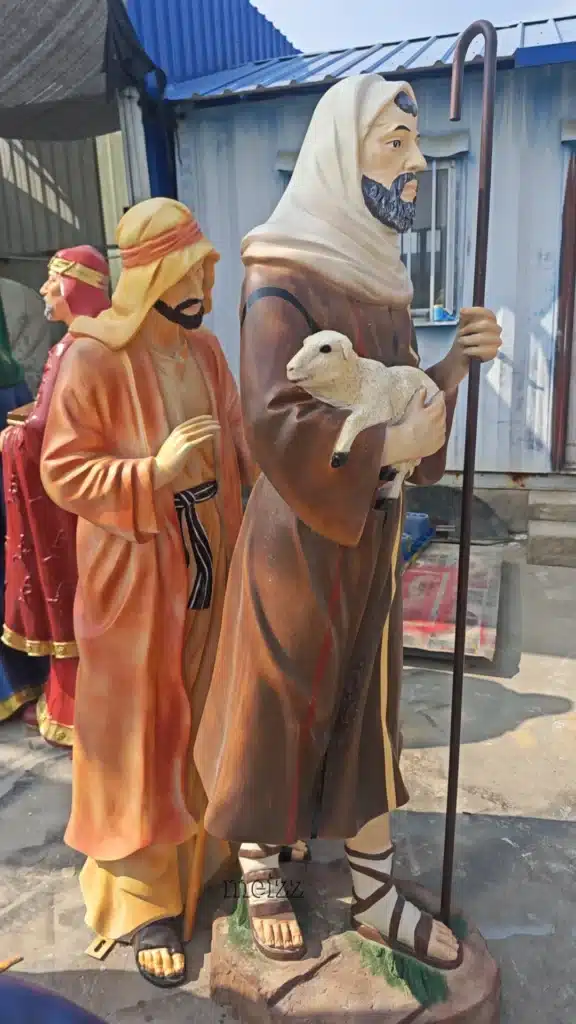
According to the Gospel narrative, shepherds received news of the birth of Jesus and came to see the child. In sculpture displays, they are often shown carrying staffs, standing with sheep, kneeling, or looking toward the manger.
A large Nativity display may include several shepherd figures rather than just one.
Their poses can also create movement within the scene. For example:
- One shepherd may stand at a distance.
- Another may kneel near the manger.
- A third may be placed beside a group of sheep.
This allows the Nativity arrangement to feel less like a straight line of statues and more like a group of people arriving from different directions.
Why Are Shepherds Important in a Nativity Scene?
The shepherds help expand the scene beyond the Holy Family. Their arrival represents the spreading of the news of Jesus’ birth and adds a sense of human activity to the display.
From a visual perspective, shepherd figures are also useful for balancing larger Nativity installations because they can be positioned at different distances from the central manger.
The Three Wise Men
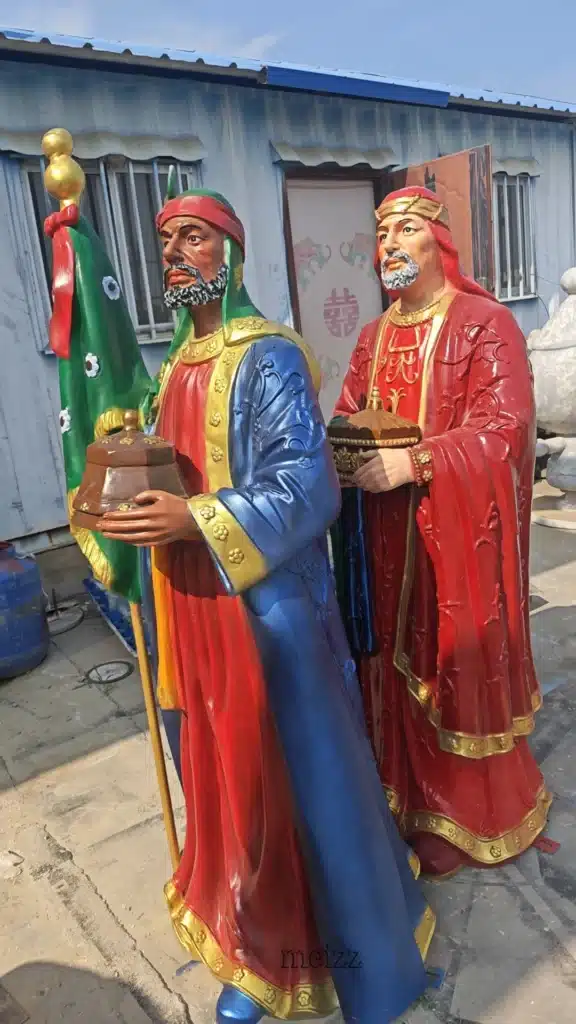
The Three Wise Men, also known as the Magi or the Three Kings, are among the most recognizable Nativity characters.
They are traditionally shown bringing gifts for Jesus.
In many Nativity sets, the Wise Men are distinguished by their elaborate clothing, crowns or head coverings, and gift containers.
The three figures are commonly identified as:
- Melchior
- Caspar
- Balthazar
However, artistic traditions may represent them differently in different regions.
Where Should the Wise Men Be Placed?
In many traditional displays, the Wise Men are not positioned directly beside the manger.
Instead, they may be placed at some distance from the Holy Family to represent their journey toward Bethlehem.
This can be particularly effective for a large church lawn, public square, or outdoor Christmas display. The Wise Men can be positioned farther away, sometimes together with camels, creating a visual journey through the entire installation.
For very large displays, this approach also allows visitors to view different groups of Nativity scene figures as they walk around the site.
Angels in the Nativity Scene
Angels are often included above or behind the main Nativity arrangement.
Depending on the sculpture design, an angel may be shown:
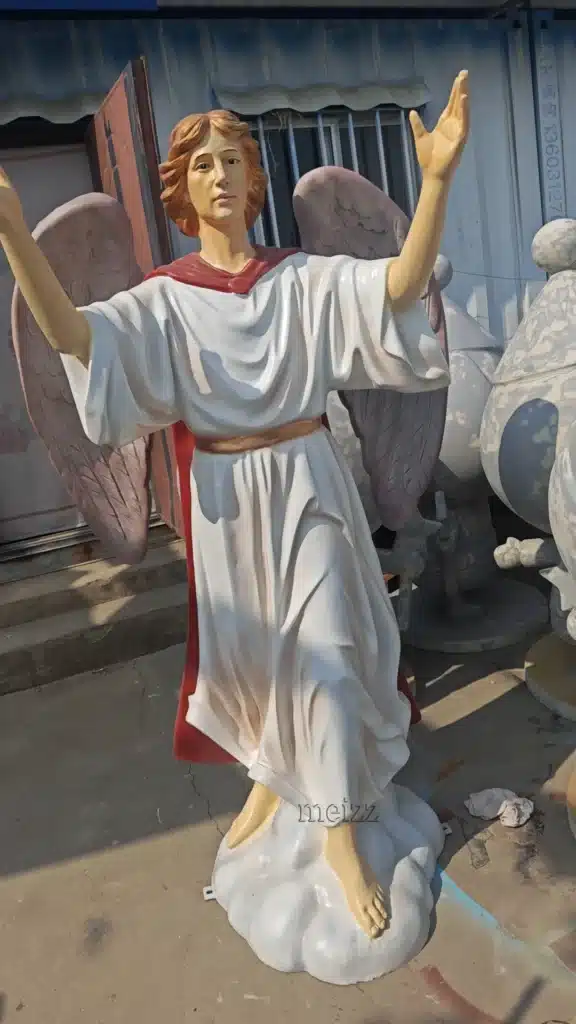
- Standing with raised arms
- Holding a banner
- Playing an instrument
- Looking toward the manger
- Appearing to announce the birth of Jesus
Unlike the Holy Family, angels do not always occupy the same physical position in every Nativity display.
In smaller sets, an angel may stand behind Mary and Joseph. In larger installations, angels can be elevated on structures, positioned near the stable, or placed separately as part of the wider Christmas decoration.
For a life-size display, the placement of an angel is especially important because a tall figure can change the overall visual balance of the scene.
What Animals Are Included in a Nativity Scene?
Animals are not simply decorative additions to a Nativity display. They help establish the setting and can make a large installation feel more complete.
Common Nativity scene animals include:
- Sheep
- Lambs
- Donkeys
- Oxen or cattle
- Camels
The exact combination varies from one Nativity set to another.
Sheep and Lambs
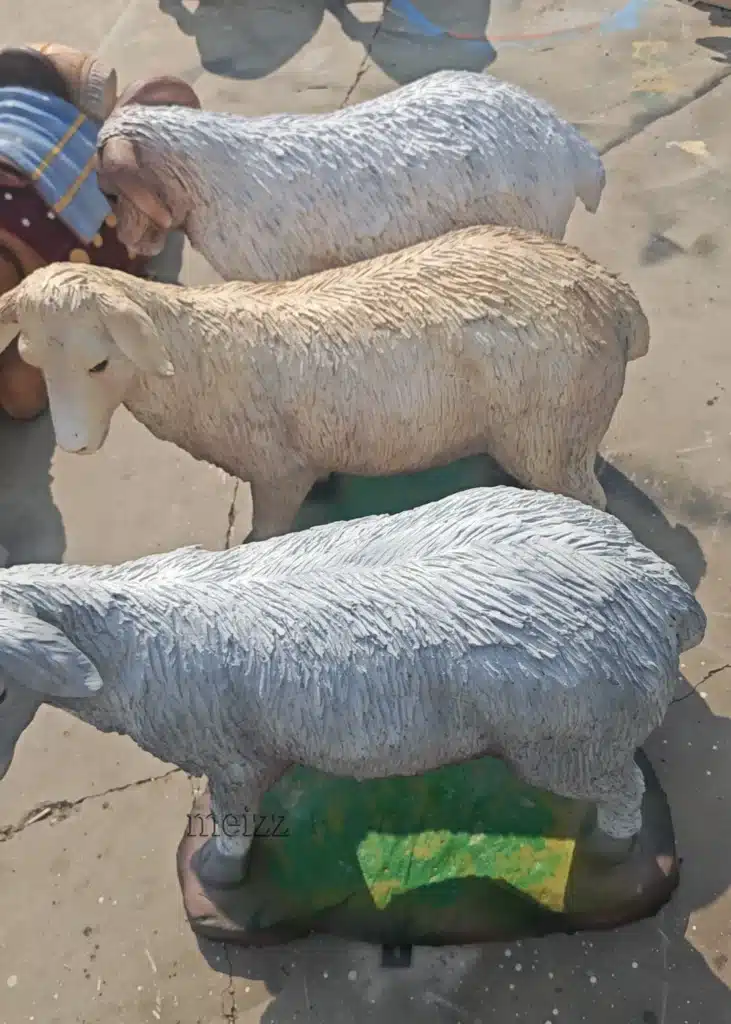
Sheep are usually associated with the shepherds and are often placed close to them.
A large Nativity scene may include sheep in different poses, such as:
Standing
Walking
Lying down
Looking toward the manger
Using animals with different poses helps avoid making the display appear too symmetrical.
Sheep are particularly useful in the foreground because their smaller size can create a gradual transition between the viewer and the larger human figures.
Donkeys
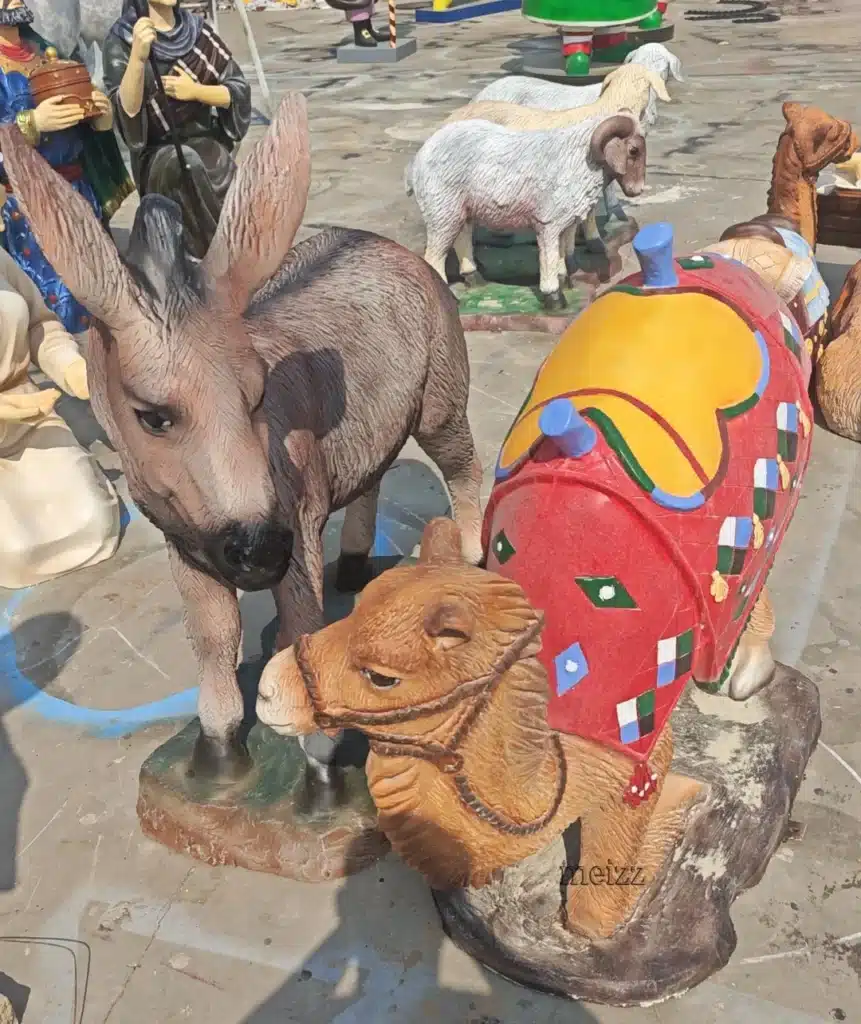
The donkey is another common figure in Nativity art.
A donkey can be placed near the stable or beside the Holy Family. In larger scenes, it may also be grouped with other animals.
From a layout perspective, a donkey has a different body shape and height from sheep or lambs, which helps add variation to the display.
Oxen and Cattle
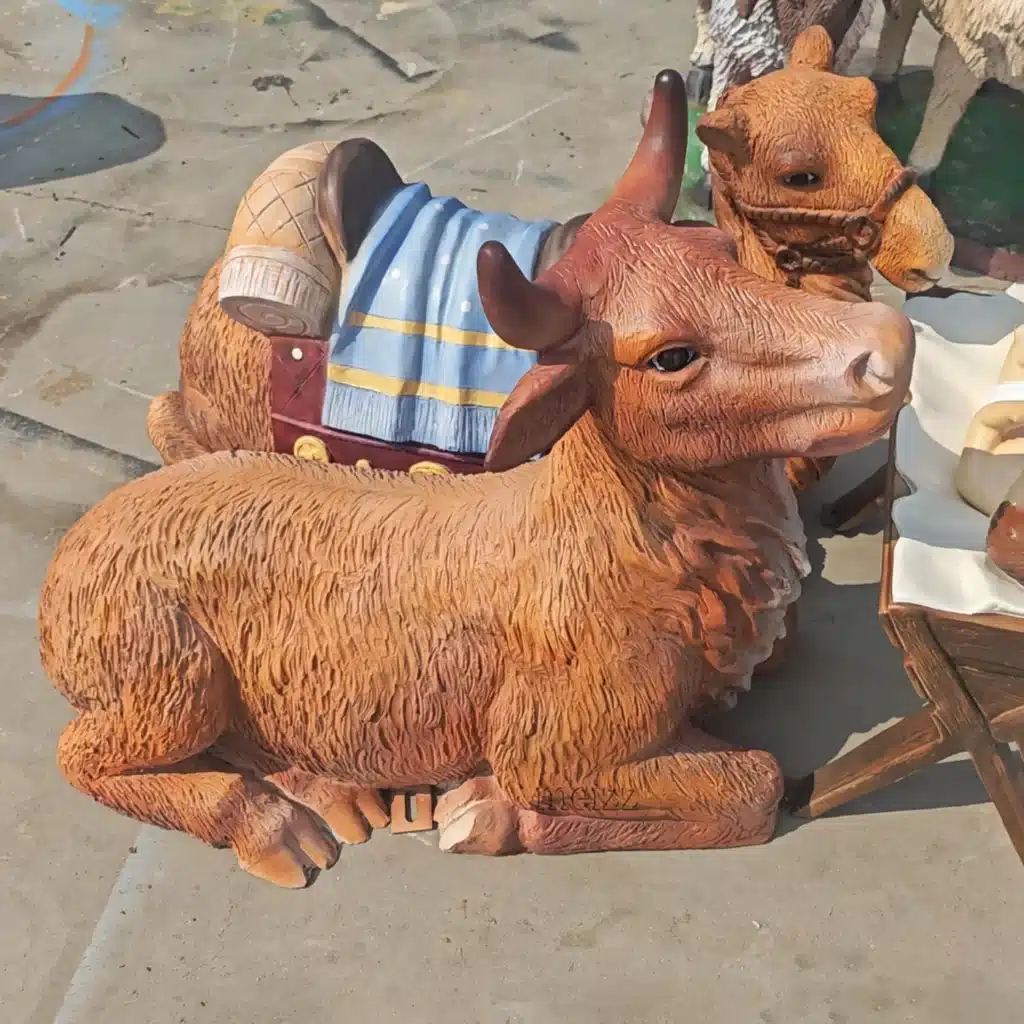
Oxen or cattle are often associated with the stable environment in traditional Nativity art.
These larger animal figures can be positioned behind or beside the manger. Their size can help visually fill the background without competing with the central Holy Family.
Camels
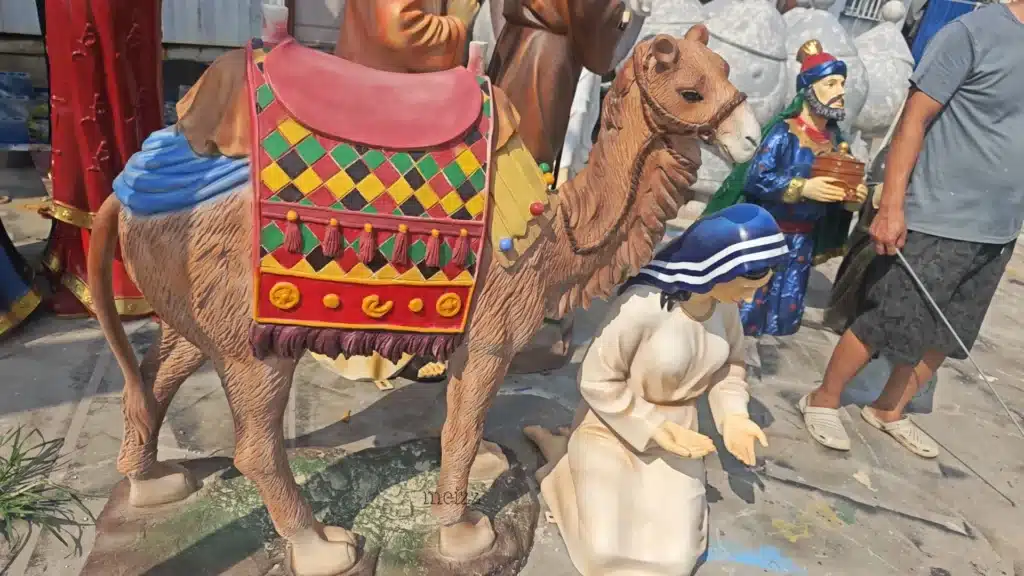
Camels are most commonly connected with the journey of the Wise Men.
For a large outdoor Nativity display, camels can be positioned with the Three Wise Men rather than directly around the manger.
This creates a separate visual group and helps tell the larger story through the arrangement of the sculptures.
A Complete Nativity Scene Does Not Need Every Figure
One common misconception is that every Nativity scene must include the same number of figures.
In reality, the size and purpose of the display can determine which Nativity scene figures are included.
A smaller arrangement may contain only:
- Baby Jesus
- Mary
- Joseph
A medium-sized display may add:
- Shepherds
- Sheep
- An angel
- A donkey
A large public installation may include:
- The complete Holy Family
- Multiple shepherds
- Several angels
- The Three Wise Men
- Camels
- Sheep and lambs
- Donkeys
- Cattle
- Additional figures and animals
The goal is not simply to add as many sculptures as possible. The figures should work together as a visual story.
How to Arrange Nativity Scene Figures
Once you know which characters you want to include, the next question is how they should be arranged.
There is no single layout that works for every location, but a traditional composition often follows a simple structure.
- Place Baby Jesus at the Visual Center
The manger usually becomes the focal point of the scene.
Mary and Joseph are positioned closest to Baby Jesus, creating the central group.
This is the area that should remain visually clear even when many additional figures are included.
- Arrange the Closest Visitors Around the Holy Family
Shepherds, sheep, and nearby animals can be placed around the central group.
Some figures can face directly toward the manger, while others can be angled slightly to create a more natural composition.
Avoid placing every figure in a straight row.
A Nativity scene generally works better when the figures are arranged in layers.
- Create a Background with Taller Figures
Standing shepherds, angels, or larger animals can be placed behind the main group.
This creates height and depth without blocking the Holy Family.
For an outdoor display, the background figures can also help the Nativity scene remain visible from a greater distance.
- Position the Wise Men as a Separate Group
The Three Wise Men and their camels can be placed farther from the manger.
This creates a second group within the larger installation and represents their journey toward the Nativity scene.
In a large public display, this can encourage visitors to walk around the entire arrangement rather than viewing everything from one position.
Three Different Nativity Scene Layout Ideas
The same collection of Nativity scene figures can be arranged differently depending on the installation space.
A Compact Church Entrance Display
This arrangement is suitable for a smaller space.
The layout may include:
- Baby Jesus
- Mary
- Joseph
- One angel
- Two shepherds
- Several sheep
The focus remains close to the manger, allowing visitors to view the entire scene from the front.
A Traditional Outdoor Nativity Scene
For a church courtyard or garden, the scene can be expanded.
The Holy Family remains in the center, while shepherds and animals are placed around them.
The Wise Men can be positioned farther away with camels, creating a wider composition.
This layout allows the story to unfold across the available space.
A Walk-Through Christmas Nativity Display
A larger installation can be designed so visitors move through different groups of figures.
For example:
Entrance → Shepherds and sheep → Angels → Holy Family → Wise Men and camels
Instead of viewing all the sculptures from a single direction, visitors experience the Nativity scene as they walk through the display.
This approach can work well for:
- Churches
- Public parks
- Town squares
- Shopping centers
- Christmas events
- Religious attractions
Indoor vs. Outdoor Nativity Scene Figures
The installation environment can affect the choice of material, figure size, and base structure.
For an indoor church display, the main considerations may include:
- Available floor space
- Ceiling height
- Viewing direction
- Visitor access
- Storage after Christmas
For an outdoor Nativity installation, additional considerations may include:
- Sun exposure
- Rain and moisture
- Wind
- Ground conditions
- Base fixing
- Seasonal installation and removal
Large public displays may also need to consider how visitors move around the sculptures.
For example, figures placed close to a walkway may require more secure installation than sculptures positioned inside a protected display area.
How Large Should Nativity Scene Figures Be?
The right size depends on where the scene will be viewed.
Smaller figures may work well inside a church or covered area where visitors can stand close to the display.
However, a large lawn, public square, or commercial property often requires larger figures to remain visible from a distance.
A life size Nativity scene can create a stronger sense of scale because visitors can walk around human-sized figures rather than looking down at a miniature display.
Before choosing the final size, consider:
- How far away visitors will view the sculptures
- The total size of the installation area
- The number of figures
- Whether visitors can walk through the display
- The height of nearby buildings or trees
- Whether the Nativity scene will be photographed from a distance
For larger projects, planning the layout before production can help avoid a common problem: individual figures may look correctly sized on their own but appear too crowded when placed together.
Choosing Materials for Large Nativity Displays
Nativity figures can be produced from different materials depending on the project.
For a large seasonal display, weight and transportation may be important considerations.
Fiberglass is commonly used for large decorative sculptures because it allows manufacturers to create human-sized or oversized figures without the extreme weight associated with solid stone or metal sculptures.
A fiberglass figure can also be manufactured as part of a larger set while allowing each character to remain an individual sculpture.
For a complete outdoor project, the structure can be planned according to the figure’s size, base design, and installation requirements.
If you are planning a large Christmas installation, you can explore our Life Size Nativity Statues collection, which includes customizable fiberglass figures such as Mary, Joseph, Baby Jesus, angels, shepherds, Wise Men, camels, sheep, and other animals.
Can You Customize the Figures in a Nativity Scene?
Yes. A Nativity scene does not have to follow one standard figure list or arrangement.
For large projects, customization may include:
- Selecting individual characters
- Adding or removing animals
- Adjusting figure dimensions
- Changing clothing colors
- Modifying the surface finish
- Creating different poses
- Adjusting the base structure
- Designing the layout according to the installation area
For example, a church may need a traditional Holy Family with several shepherds, while a commercial Christmas display may require a much larger collection of Nativity scene figures that can be viewed from multiple directions.
The final arrangement should be planned according to both the story you want to represent and the physical space available.
Frequently Asked Questions About Nativity Scene Figures
Who are the main figures in a Nativity scene?
The main figures are Baby Jesus, Mary, and Joseph. These three characters form the Holy Family and are usually placed at the center of the Nativity scene.
What other characters can be included in a Nativity scene?
Additional Nativity scene figures can include shepherds, angels, the Three Wise Men, sheep, donkeys, camels, cattle, and other animals depending on the size and tradition of the display.
Do the Three Wise Men have to be placed next to Baby Jesus?
Not necessarily. Many Nativity displays place the Wise Men farther away from the manger to represent their journey toward Bethlehem.
What animals are traditionally included in a Nativity scene?
Common animals include sheep, lambs, donkeys, oxen or cattle, and camels. The exact animals can vary depending on the style and scale of the display.
How should Nativity scene figures be arranged?
A common arrangement places Baby Jesus, Mary, and Joseph at the center. Shepherds and animals are positioned around them, while taller figures can be placed toward the back. The Three Wise Men and camels may form a separate group farther away.
Can a Nativity scene be installed outdoors?
Yes. Outdoor Nativity displays can be designed for church grounds, gardens, public squares, parks, and Christmas events. The sculpture material, base structure, and fixing method should be selected according to the installation environment.
Create a Nativity Scene That Fits Your Space
From a simple Holy Family display to a large public Christmas installation, Nativity scene figures can be arranged in many different ways.
The most important starting point is understanding the role of each character. Mary, Joseph, and Baby Jesus form the center of the story, while shepherds, angels, Wise Men, and animals expand the scene and create a broader visual narrative.
For a small display, only a few figures may be needed. For a church, plaza, park, or commercial Christmas project, the Nativity scene can become a larger installation with multiple groups of characters and animals arranged throughout the space.
If you are planning a full-size display and need customizable figures, dimensions, or layout options, you can explore our Life Size Nativity Scene Statues and select individual figures or develop a complete fiberglass Nativity scene for your project.
From the Nativity to Other Christian Sculpture Traditions
Nativity scenes focus on the beginning of the Christian story—the birth of Jesus. However, Christian sculpture also represents other important moments in the life of Christ.
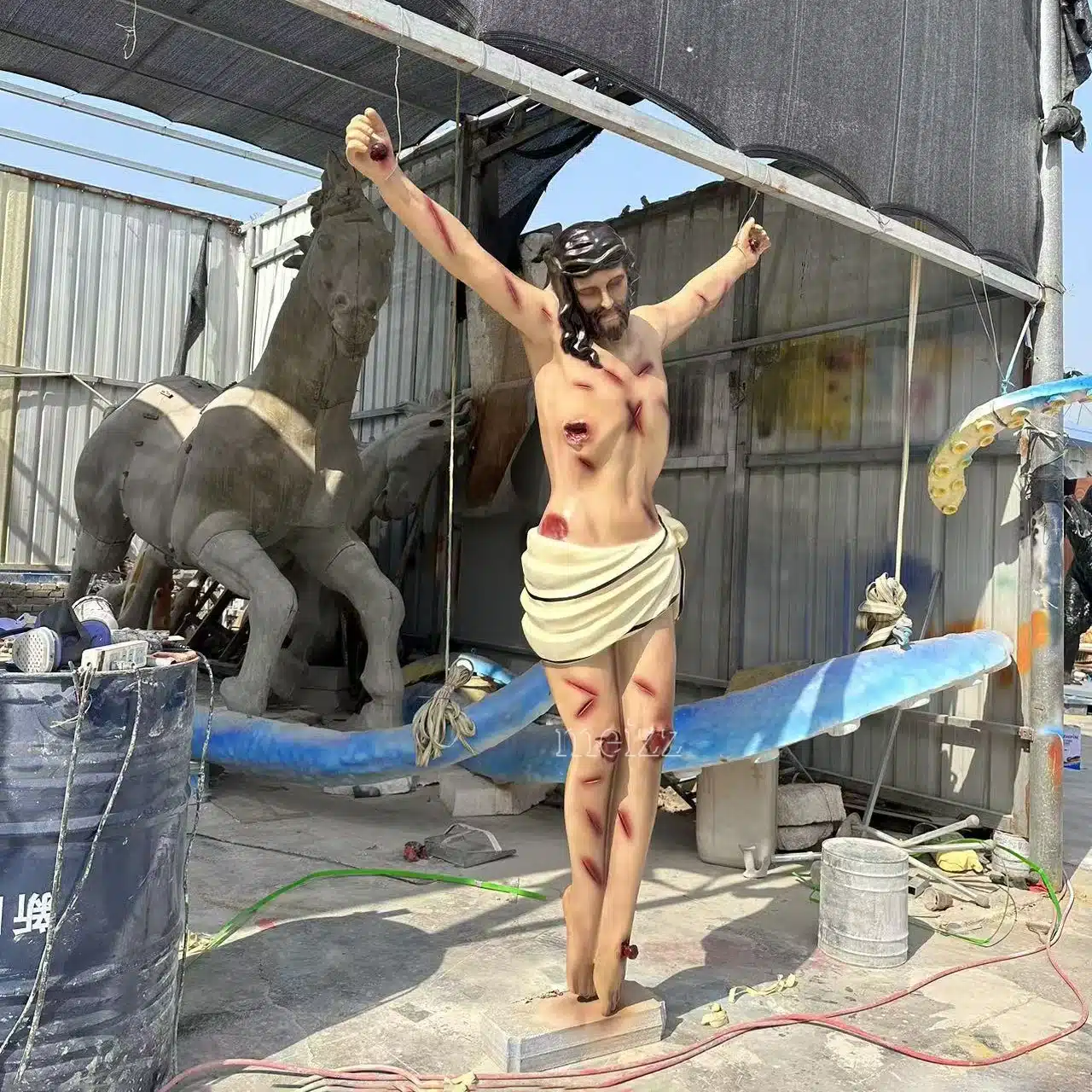
One of the most widely recognized forms is the Jesus on the Cross statue, which represents a very different moment in the Christian narrative and is commonly used in churches, religious gardens, memorial spaces, and other places of worship.
While Nativity figures are usually displayed together as a complete Christmas scene, a cross statue is often created as an independent religious sculpture. You can learn more about the different styles, uses, and designs of a Jesus on the Cross statue in our detailed guide.